By Helena El-Masri, DPSI Online MoJ Setting the Scene The Ministry of Justice’s new contract…
Languages in higher education in the UK are in a sorry state, but all is not lost. The language services industry, and language service companies, still rely on highly qualified linguists, translators, interpreters and language specialists. The UK’s position in global markets and the success of UK companies’ exporting activities still hinges on multilingual communication. This ATC special newsletter outlines recent developments and sets out what we can do about it together.
The Latest on Language Learning
Language learning in the UK is facing a sustained decline, with fewer students taking up foreign languages and a shrinking pool of qualified teachers. Despite growing interest in languages like Spanish and Mandarin, long-term trends show a significantly reduced uptake, particularly in French and German.
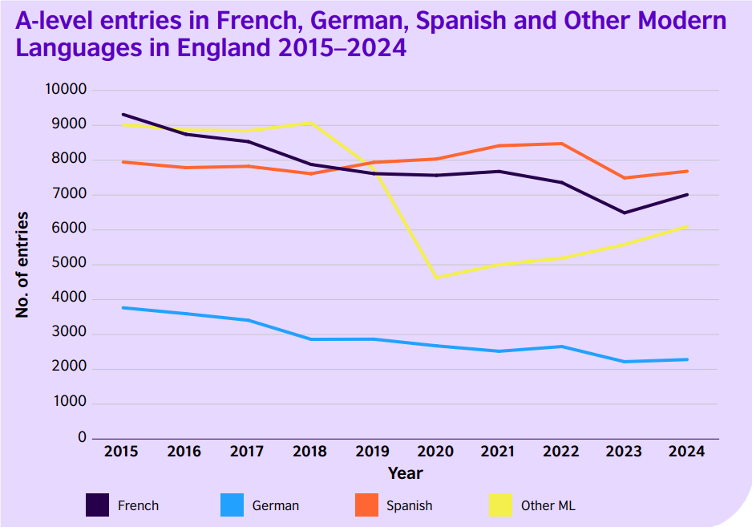
British Council’s Language Trends England 2025 charts the development of A-level entries in French, German, Spanish and other modern languages in 2015-2024:
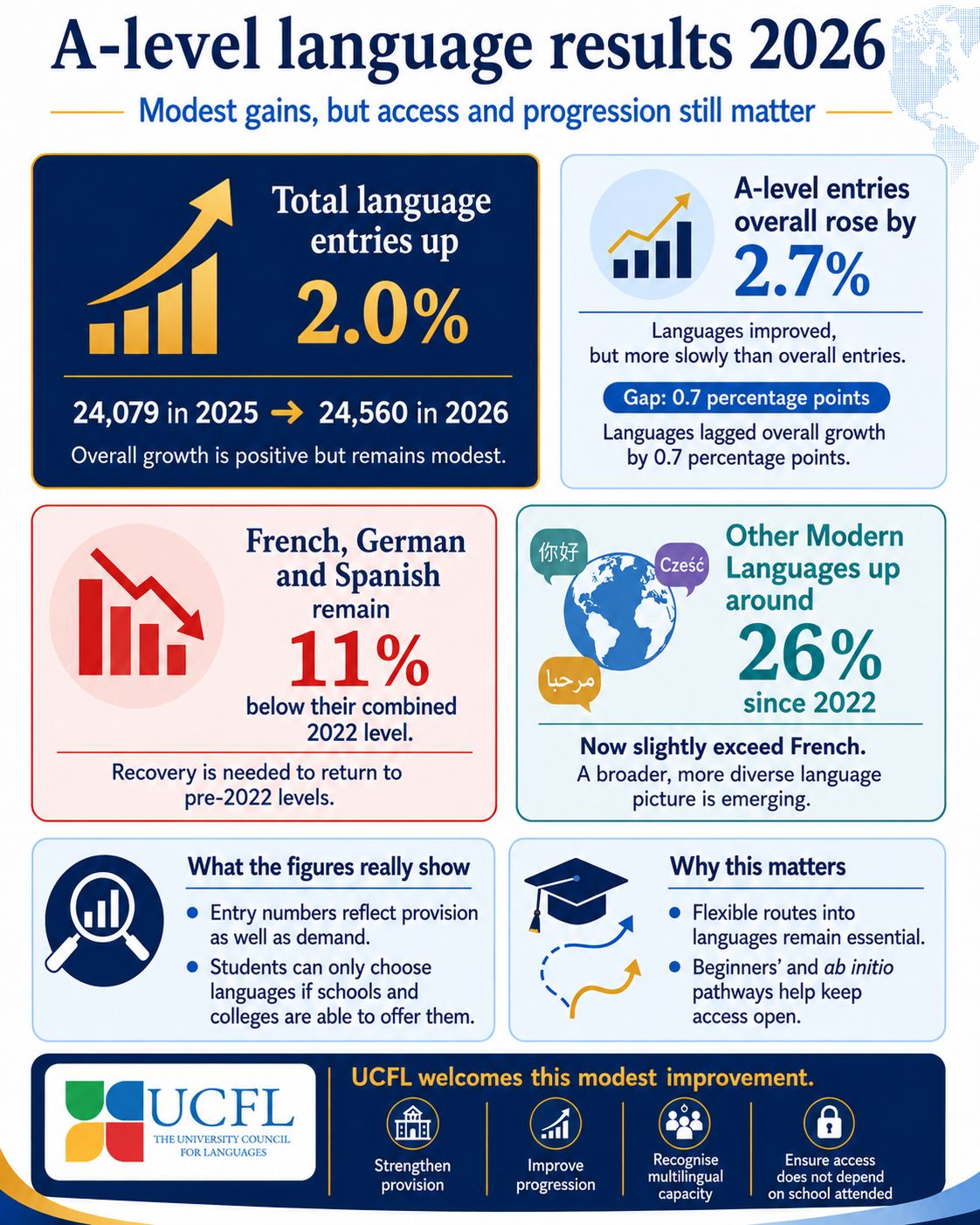
However, the 2026 A-level results bring some welcome news for languages, as the infographic produced by Marcela Andrea Cazzoli, Professor of Spanish and Applied Linguistics at Durham University and the Vice Chair, Language & Intercultural Education at The University Council For Languages:
University Closures Are Accelerating
A tangible outcome of a long period of decline is the accelerating speed of universities closing or threatening to close down their languages, translation studies, interpreting, or applied languages degrees.
In the past five years, we have heard of closures at Aston, Hull, Lincoln, and Leicester, reduced degree programmes in Aberdeen, Sheffield, and Cardiff, and imminent threats at Nottingham and Exeter. The reasons are predictably regrettable: financial pressures and the proportionally higher cost of teaching language degrees, the long-term promotion and preferential position of STEM subjects, the spanners in the works put on by Brexit on overseas students and years away, and yes, the perceived impact of AI on languages professions.
In a recent blog, Professor Pierre-Alexis Mével, Professor of Media Accessibility and Audiovisual Translation at the University of Nottingham explores what the situation in Nottingham tells us about the national picture for Modern Languages – a case study in a national pattern of fragility, regional inequality and strategic misalignment between institutional pressures and the country’s long‑term skills needs.
What We Are Doing About It Together
This picture is not a pretty one, but it has galvanised the UK’s languages ecosystem, bringing together universities, associations, and language professionals to lobby for a common cause.
The ATC is working closely with the Institute for Translation and Interpreting (ITI) and the Chartered Institute of Linguists (CIOL) to present a strong, united industry front urging UK universities to protect and strengthen their language provision. The three professional bodies are calling on universities to recognise language provision as a strategic investment, drive innovation in course design, and build stronger partnerships with employers and professional associations.
Making the case for languages in UK higher education sets out the strategic, economic and cultural arguments for maintaining language degrees and translation and interpreting programmes in the light of the worrying trend that has seen 28 universities close modern languages courses since 2014.
The ATC also supports the aims and the work of APTIS, All Party Parliamentary Group on Modern Languages and The University Council For Languages, as well as the National Consortium for Languages Education.
Our special task is to showcase the value of language capabilities and language services to the UK’s multicultural society, exporting, and international trade. The ATC works closely with our University Partners to support employability through career talks, connect language service companies to their local universities, and collaborate on topical, industry-relevant research projects.
Call to Action
We need your help. Employability and industry relevance are critical elements needed to convince universities to keep their languages, translation, interpreting, and applied languages degrees alive.
To add your voice as an employer and a key stakeholder within the language services ecosystem, write to ATC CEO Raisa McNab at ceo@atc.org.uk and give permission to use your name, position and company name in our advocacy and lobbying activities. Share what saving the UK’s languages education and securing the pipeline of future talent means to you and your business.
Related Posts