ATC Technology Showcase with LBS Suite Mastering End-to-End AI Production Workflows: Agentic Localisation in Practice…
Advocacy in action is about proactive engagement and raising our voices where it makes a difference. When it comes to working towards securing the future of language learning in the UK and promoting the value of languages and language services to the economy, exporting and international trade, a multicultural society, and civil services, advocacy is a long game.
On 8 July 2026, the Guardian newspaper published a joint letter by the ATC, ITI and CIOL, warning that cutting university language courses is a costly mistake.
Co-written by Raisa McNab, CEO of the Association of Translation Companies, Sara Robertson, Chief Executive of the Institute of Translation & Interpreting, and John Worne, Chief Executive of the Chartered Institute of Linguists, the letter was submitted as a response to the news that the University of Exeter is planning to cut 150 jobs, which are expected to disproportionately fall on the humanities, arts and social sciences – including modern languages.
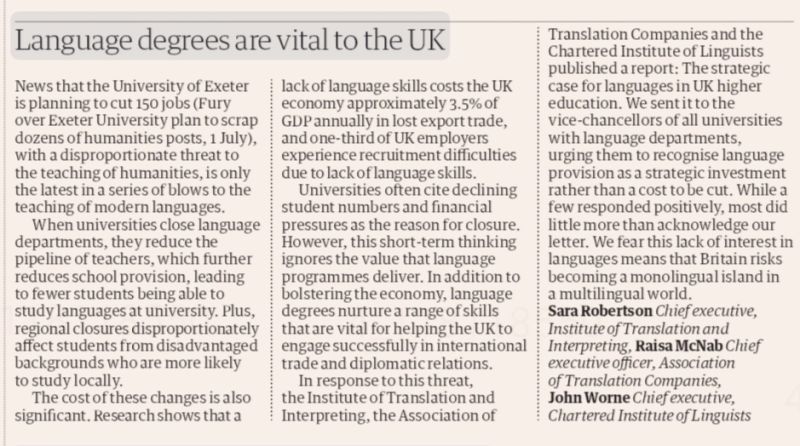
As cited in the letter, “research shows that a lack of language skills costs the UK economy approximately 3.5% of GDP annually in lost export trade, and one-third of UK employers experience recruitment difficulties due to lack of language skills. However, small and medium-sized enterprises that do possess language capabilities are 30% more successful in exporting.”
The letter further points out that “universities often cite declining student numbers and financial pressures as the reason for closure. However, this short-term thinking ignores the value that language programmes deliver. In addition to bolstering the economy, language degrees nurture a range of skills that are vital for helping the UK to engage successfully in international trade and diplomatic relations.”
As part of their joint advocacy work, the ATC, ITI and CIOL published the report The strategic case for languages in UK higher education, which they sent to vice‑chancellors of all universities with language departments, “urging them to recognise language provision as a strategic investment rather than a cost to be cut.
The message is the same across the UK, and Languages in a Global Scotland, a new report published on 26 June 2026 by the Scottish Arts and Humanities Alliance (SAHA), argues that languages and intercultural studies are key to creating a Global Scotland for the benefit of all. Referring to recent studies on the value of languages as well as to the ATC-ITI-CIOL paper, the report provides a snapshot of key areas, illustrating the current situation in the context of modern languages, Gaelic, Scots, and British Sign Language in Scottish Higher Education, the challenge of teacher recruitment, multilingualism, languages and soft power, and the challenges and benefits of AI.
If you would like to speak to us about our advocacy work to promote the value of language services, and for all media enquiries, please contact secretary@atc.org.uk.
Related Posts